Mesonet Ticker for August 21, 2026
MESONET TICKER ... MESONET TICKER ... MESONET TICKER ... MESONET TICKER ...
August 21, 2026 August 21, 2026 August 21, 2026 August 21, 2026

Tired of the extreme heat? So over the lack of rainfall (even though Heck, it's
raining right now for crying out loud!)...

Well stay tuned, because we have a strong/very strong/historically strong El Nino
coming to an Oklahoma near you. Well, down in the Equatorial Pacific, but it's
felt pretty Pacific lately as far as the heat goes, so go figure.
I'm not gonna bore ya (I HEARD THAT!) with yet another admonishment about trying
to make El Nino impacts "a thing" in our part of the world too early. I have
battled that since May (for crying out loud), but we're getting closer I tell you.
We could have worse things coming, for sure. Like Gozer the Traveler. He will
come in one of the pre-chosen forms. During the rectification of the Vuldrini,
the traveler came as a large and moving Torg! Then, during the third
reconciliation of the last of the McKetrick supplicants, they chose a new form
for him: that of a giant Slor! Many Shuvs and Zuuls knew what it was to be
roasted in the depths of the Slor that day, I can tell you!
Hmmm, if only there was somebody we could call about that.
Anyway, we also have September to get through, and it's influence on our overall
fall weather, which you can see in the September outlook AND the September-November
outlook. Continued hot, because above-normal temps in September usually means hot.
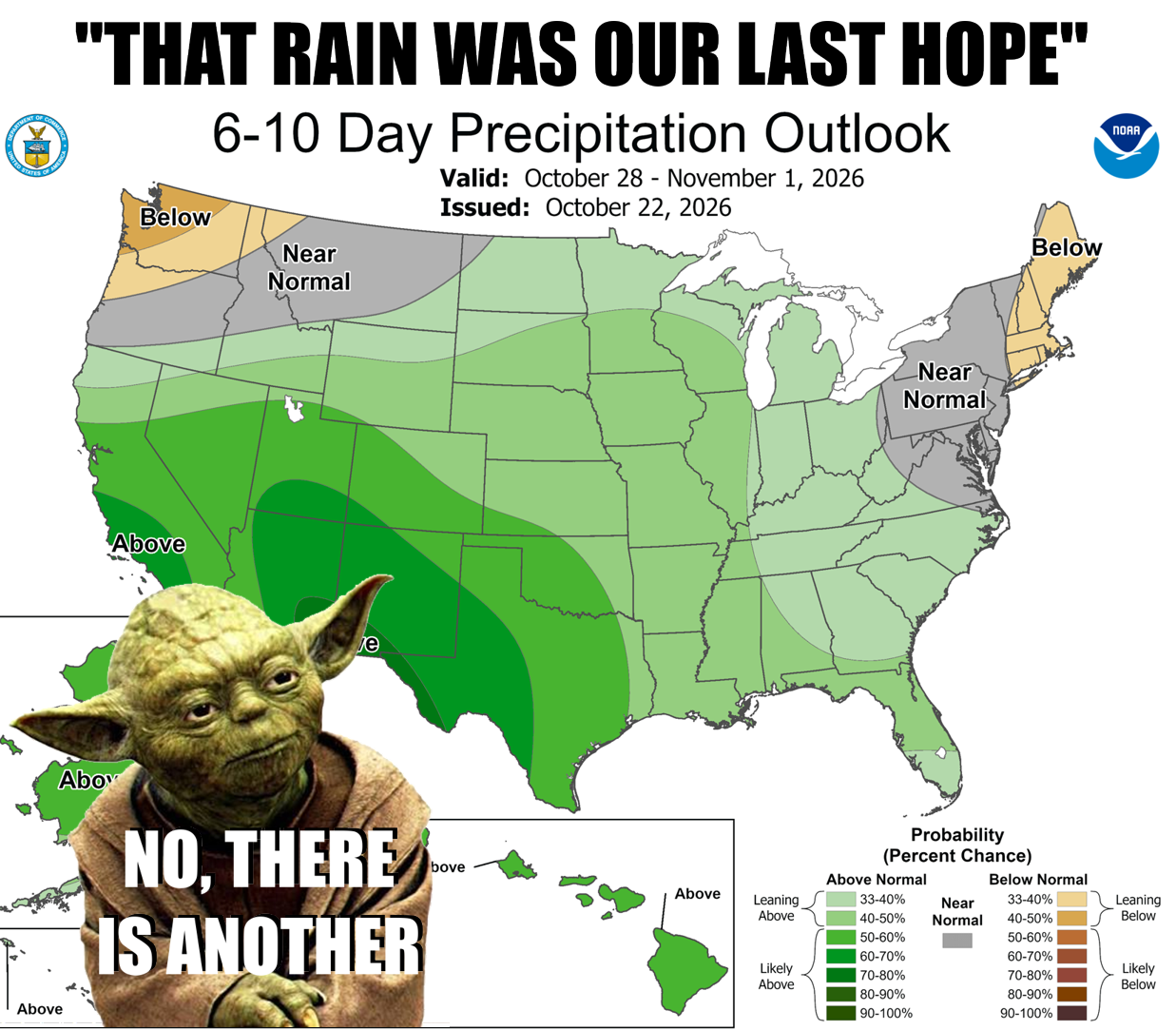
We can also see El Nino's wet signal (and we all know just how painful that can
be) trying to spread east, but there are two things keeping CPC from making the
whole southern Plains strongly wet this fall.

First, recent Sept-Nov precipitation trends are dry across the eastern Plains and
Mississippi Valley, opposing the El Niño composites. Second, their closest
analogs to this particular eastern-Pacific El Nino suggest that the classic
southern-tier wet pattern may be delayed rather than fully developed during Sept-
Nov. That's why CPC puts EC over the eastern southern Plains/Lower Mississippi
Valley while retaining the wet signal farther west.
So it's trying, and remember that's an average look at 3-month periods, so
September's lack of signal influences the whole thing, and so as we get into
October and November, the impacts could be showing up more strongly.
Or not at all...it's not a guarantee for sure.
So the El Nino wet signal is trying to push eastward into the state, while the
recent dry climatological tendency is pushing back from the east.
A battle of the tendencies, I guess you could say. I can sympathize, my scalp
went through a battle like this over the last few decades. The bald signal won.
You get over it (not really..."SNIFFLE").
As fall gives way to winter, CPC expects the strengthening El Niño to impact more
strongly and the precipitation signal becomes much more classically El Niño-like:
wetter-than-normal conditions become increasingly favored across the southern
tier and central Plains, then strengthen during the heart of winter across
California, the Southeast and much of the East Coast. Drier-than-normal
conditions are favored farther north across portions of the northern Rockies,
northern High Plains and Great Lakes. By spring, those El Niño influences are
expected to fade, with the wet signal gradually retreating from the East Coast
and Southwest and longer-term climate trends playing a larger role in the
outlooks.
But those impacts for strong and very-strong (probably historic, as noted
earlier) El Nino episodes are very real, historically. Don't let any clodhoppers
tell you otherwise.

Ya see, looking at October-April periods associated with strong and very strong
El Niños since 1950, much of Oklahoma has landed in the wettest third of years
roughly 60-80% of the time, while temperatures have fallen into the coolest third
roughly 60-70% of the time. That cool-and-wet signal stretches across much of the
southern tier, while the northern U.S. shows nearly the opposite temperature
response. Of course, these are historical frequencies rather than a forecast for
this year—El Niño loads the dice, but Mother Nature still gets to roll 'em.
We'll see what this one does. It's a darn sight better than La Nina, amirite? Less
drought, less heat, less fire danger.
Hey, speaking of fire, did you know our award-winning OK-FIRE program is having
an additional in-person workshop, and instead of only being held in the fall, we
have options in February now as well?
It's true...check out the announcement.

Now, we just have to survive the rest of August and maybe September before we're
basking in the warm (mild-to-cool) glow of a Super (very strong-to-historic) El
Nino.
Gary McManus
State Climatologist
Oklahoma Mesonet
Oklahoma Climate Survey
gmcmanus@ou.edu
August 23 in Mesonet History
| Record | Value | Station | Year |
|---|---|---|---|
| Maximum Temperature | 113°F | ALTU | 2024 |
| Minimum Temperature | 52°F | NOWA | 2009 |
| Maximum Rainfall | 5.40 inches | BEAV | 2019 |
Mesonet records begin in 1994.
Contact the Ticker
Follow the Ticker via the Mesonet social media accounts on Bluesky, X, or Facebook, or subscribe to our RSS feed.
To subscribe to or unsubscribe from the Ticker mailing list, or for questions about the Ticker or its content, please contact the Ticker Manager at OCS:
(405) 325-2253